Launch offer — valid today only

📄 Digital book in PDF · read it on your phone or print it

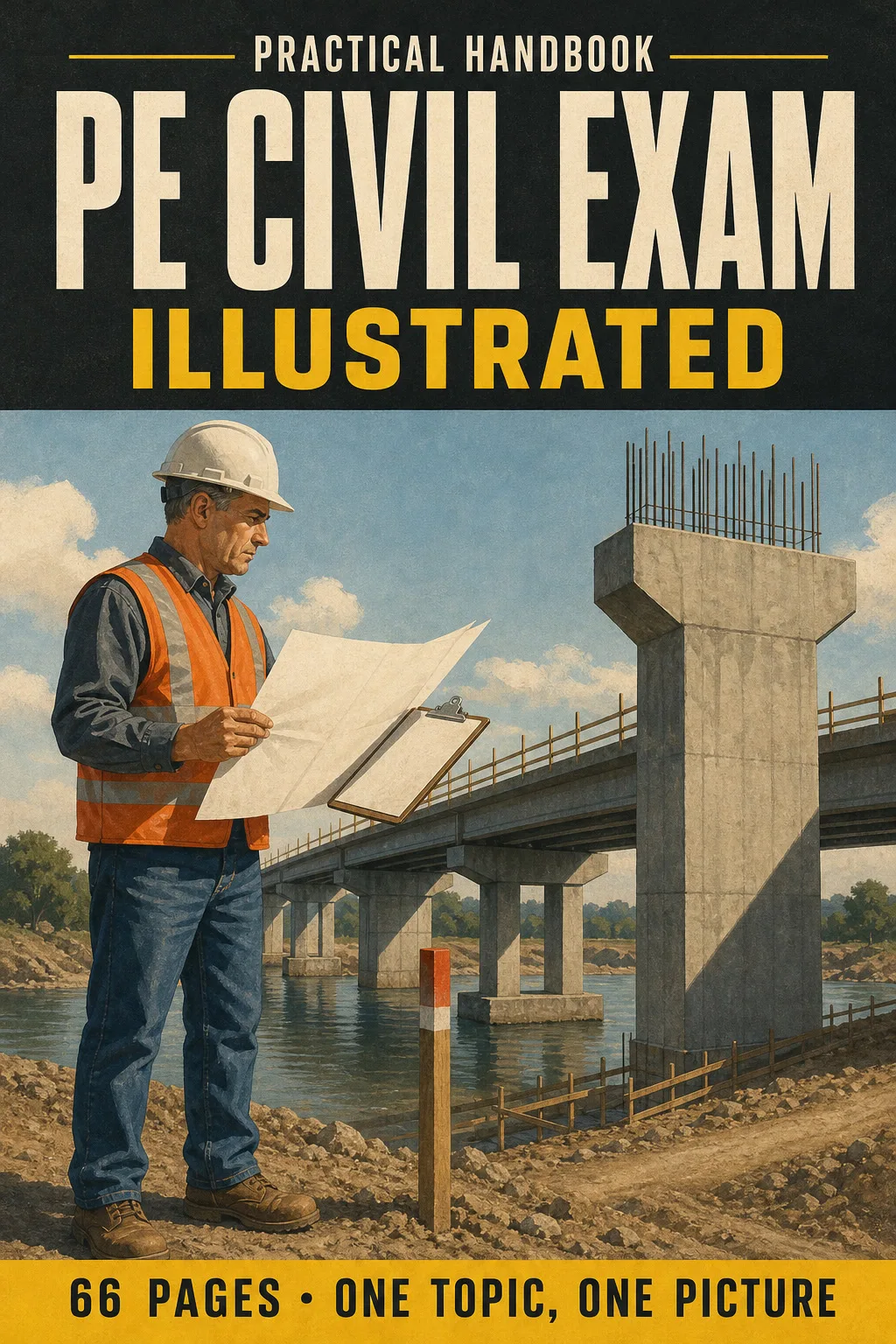
The PE Civil Core in Drawings, So the Equations Finally Connect One Topic, One Page, Same 4 Steps

Soil phases, bearing capacity, LRFD loads, shear and moment diagrams, horizontal curves, Manning's equation, earthwork and the handbook search. Each topic has its own page: the drawing, the equations with US units and a worked example. 66 illustrated pages.

START STUDYING THIS WAY

🔒 Secure checkout · PDF by email · 30-day guarantee

Every topic, its own pageEvery worked example in the same 4 steps: sketch it, list the givens with units, find the handbook equation, solve and check units
66 illustrated pages7 parts, from how the exam works to your exam-day plan
Up-to-date sourcesNCEES PE Civil specifications, the PE Civil Reference Handbook, ASCE 7 and ACI 318
PDF by emailFormat

Look Inside the Book

Every page has one big drawing and a box with the equations, numbers and units you need to know:

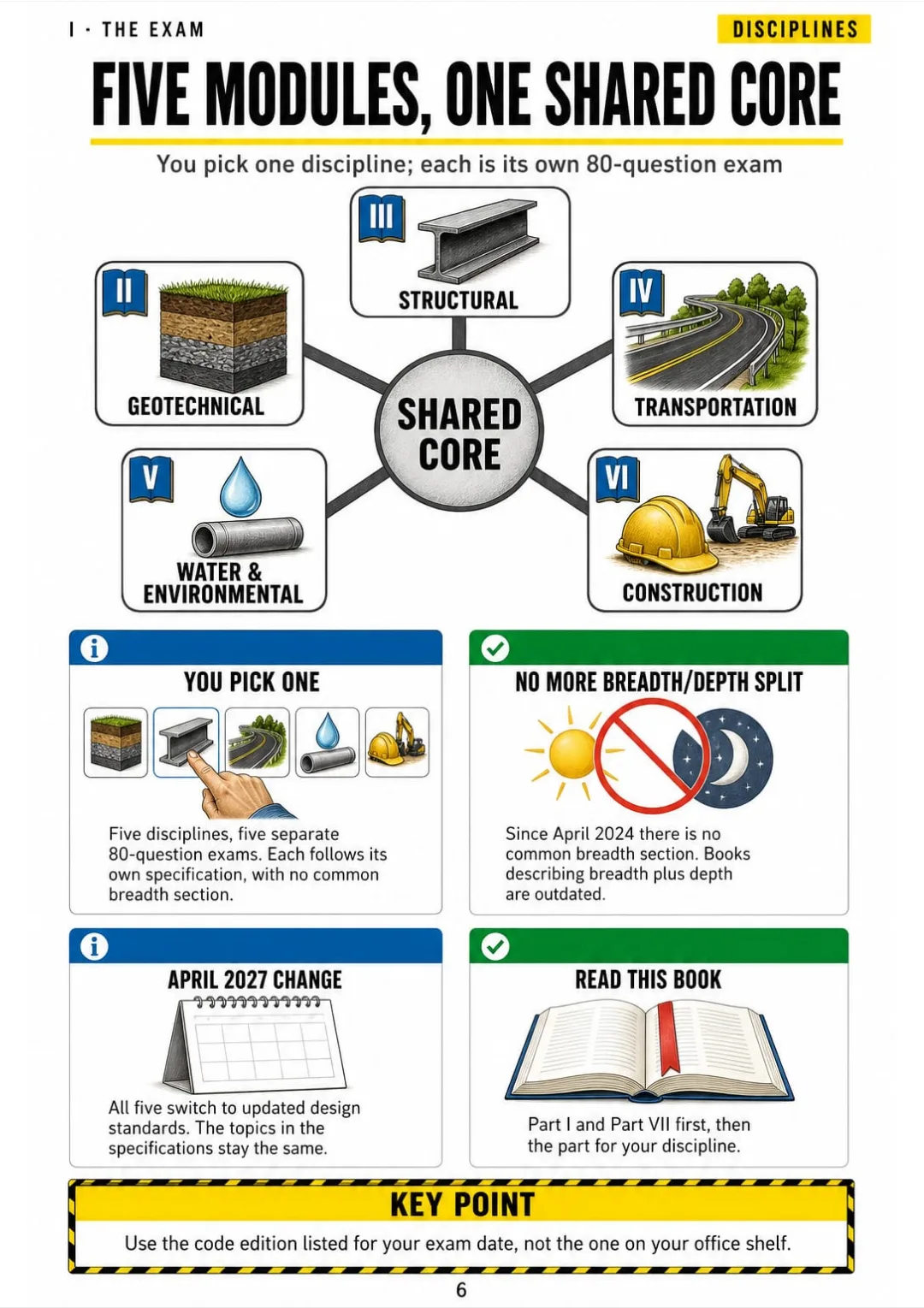
80 questions · 8-hour exam inside a 9-hour appointment · handbook and standards onscreen
5 disciplines, 1 exam each · topics unchanged, standards updated from April 2027
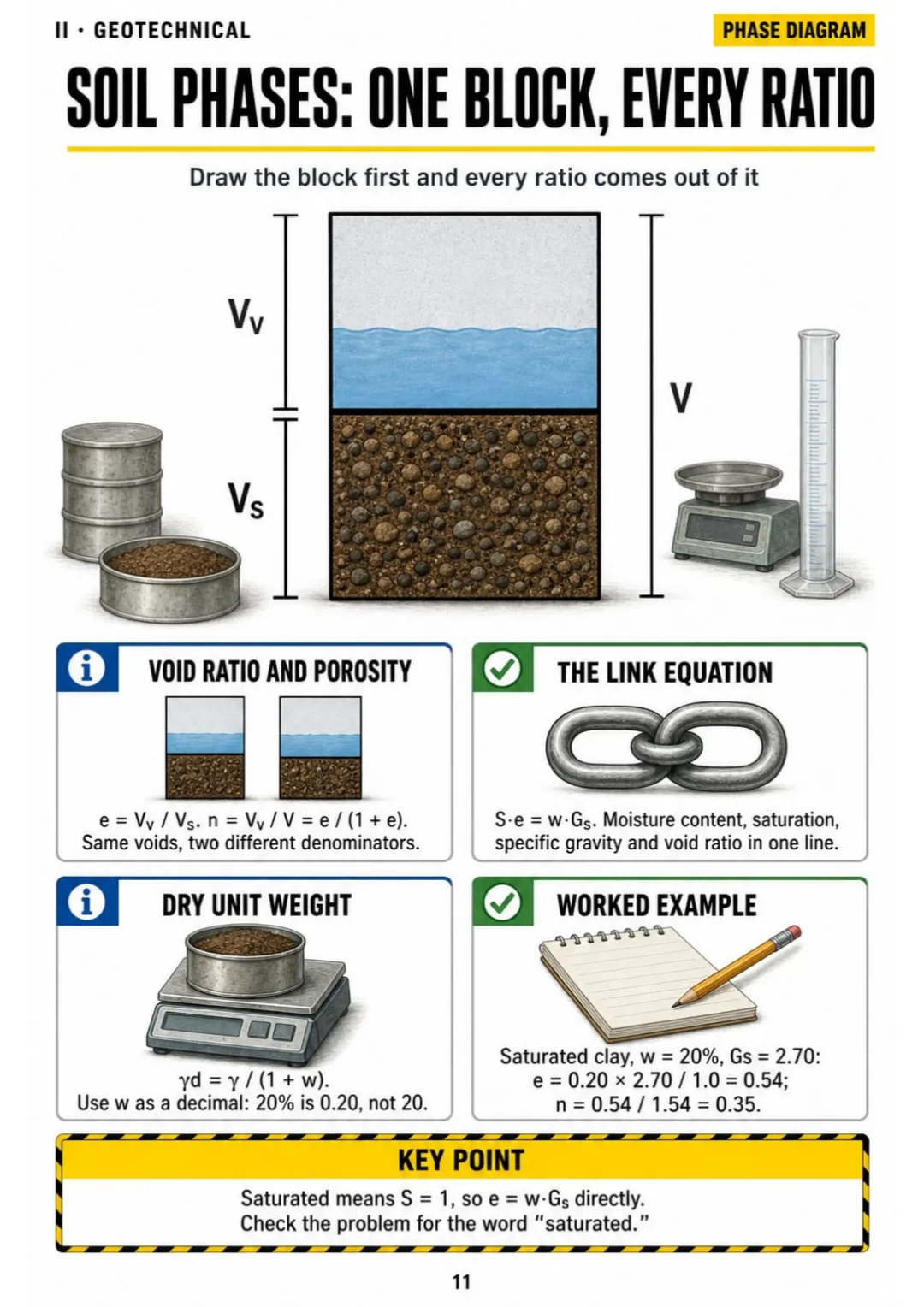
S·e = w·Gs: saturated clay with w = 20% and Gs = 2.70 gives e = 0.54
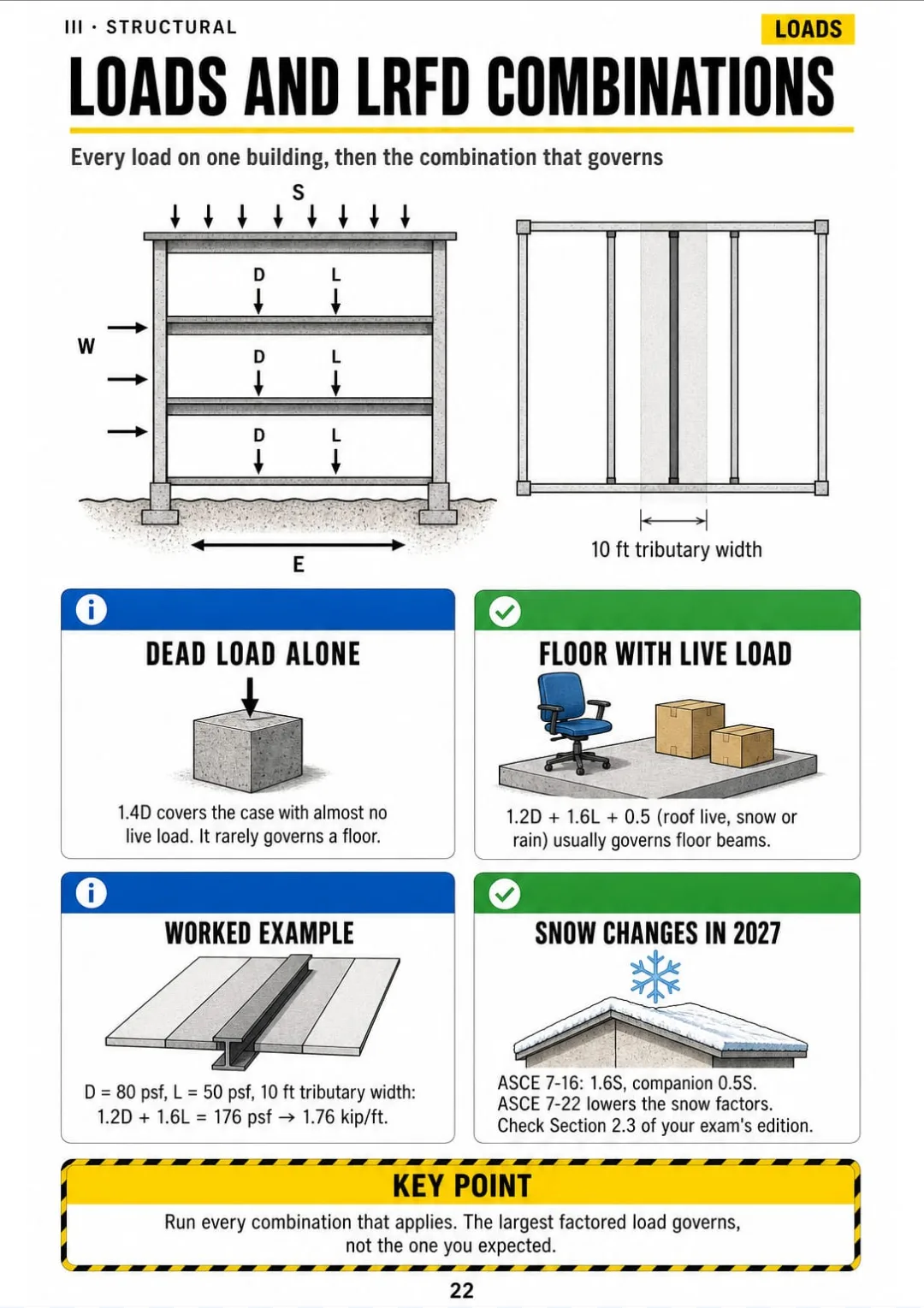
1.2D + 1.6L on a 10 ft tributary strip: 176 psf → 1.76 kip/ft on the beam.
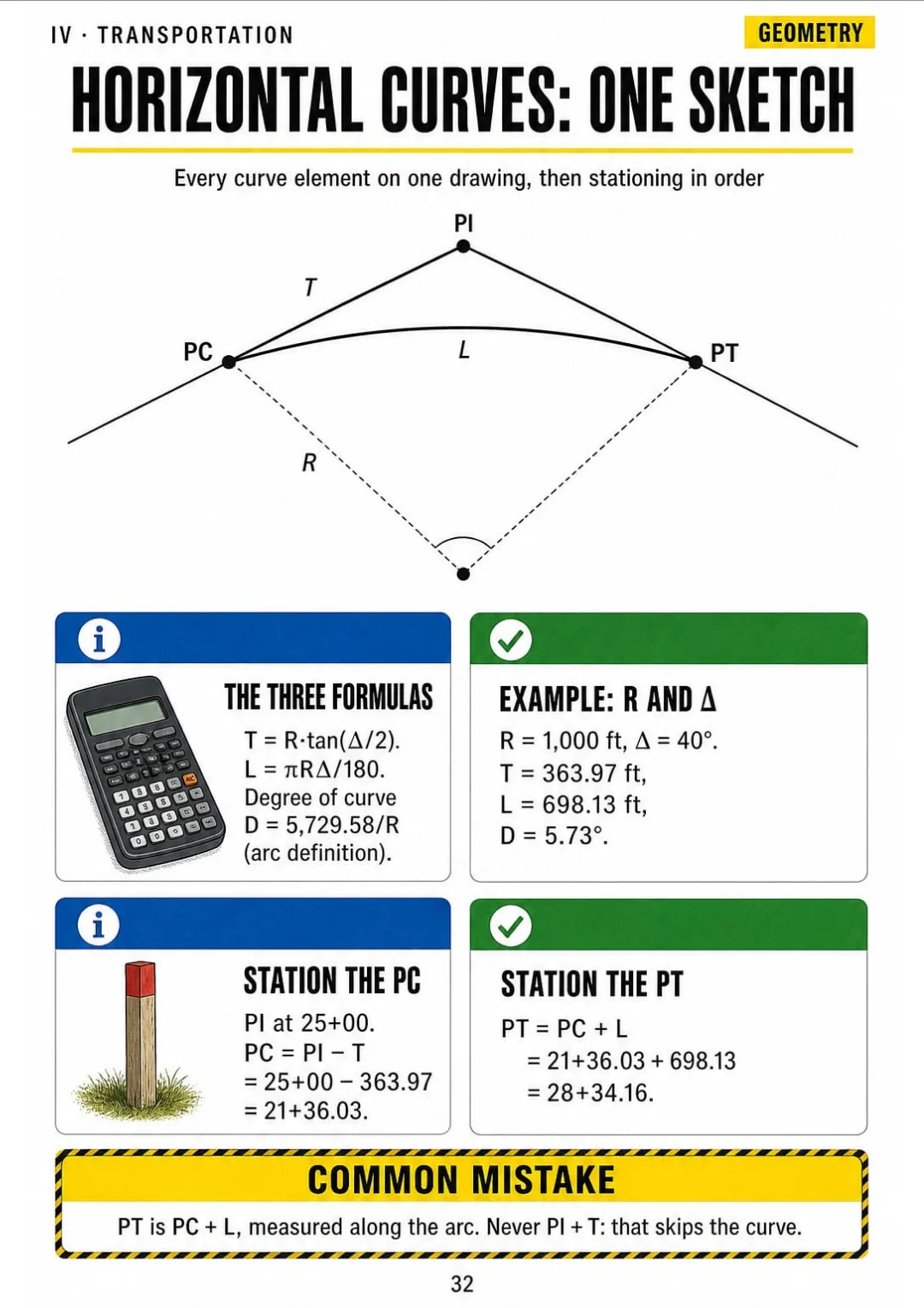
T = R·tan(Δ/2), L = πRΔ/180: PT station = PC + L, never PI + T.
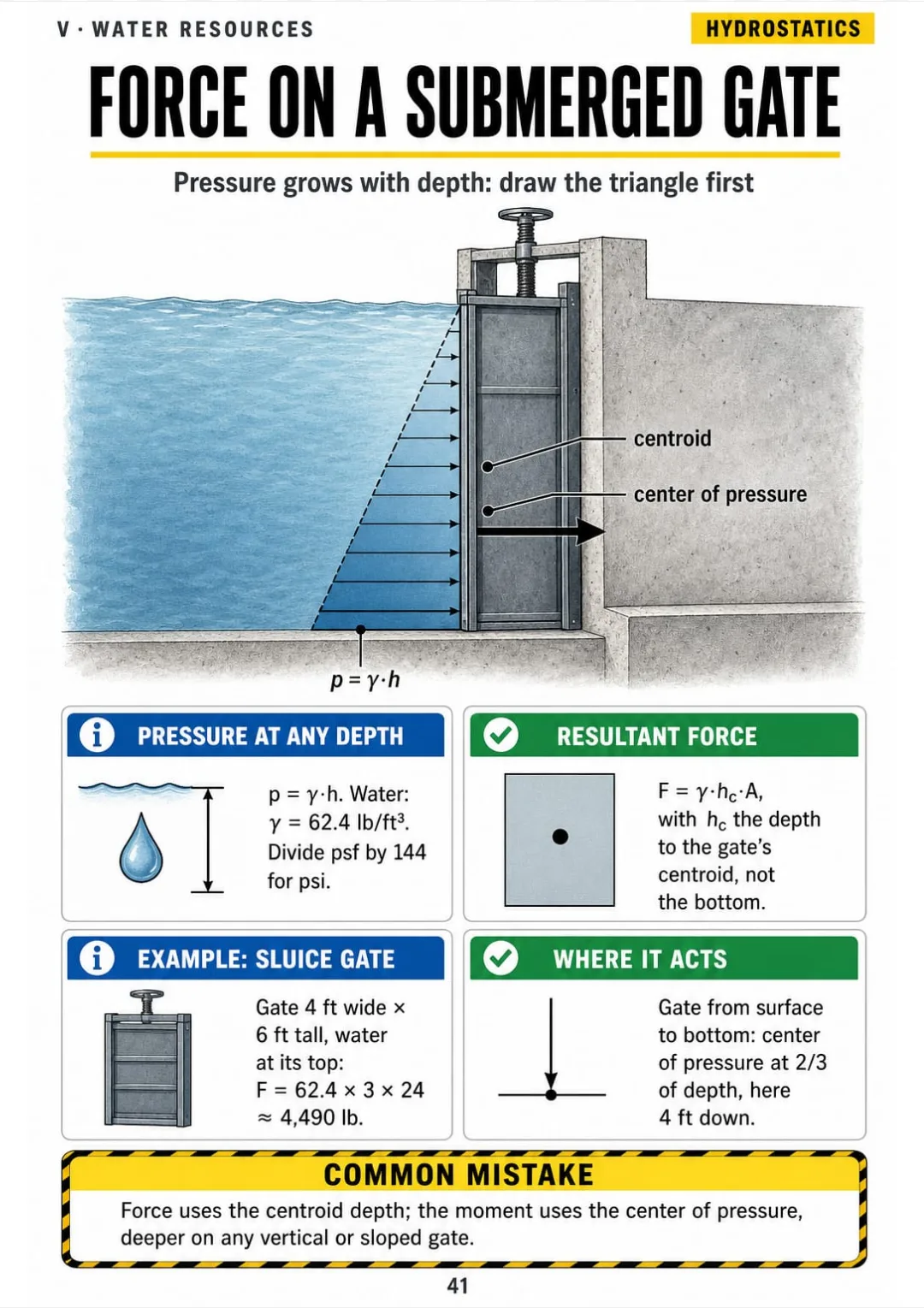
Gate 4 ft wide, 6 ft of water: about 4,490 lb, acting 4 ft below the surface.
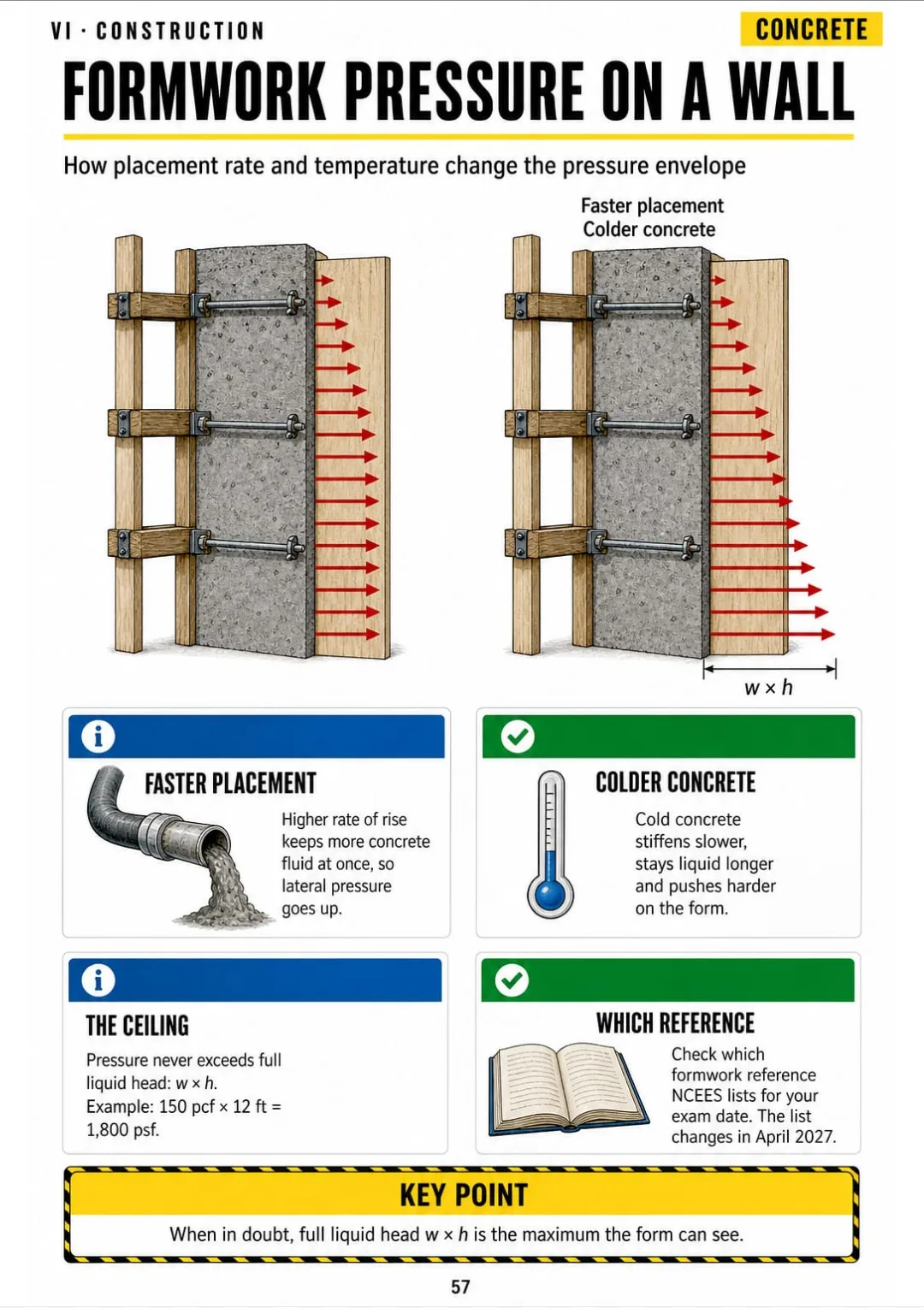
Maximum pressure on a 12-ft wall form: 150 pcf × 12 ft = 1,800 psf
Topic → bookmark → one term → units → your 4-step box

Swipe to see more →

These are real pages from the book. The table of contents is the full one: 7 parts and 62 topics.

The Problem Isn't You. It's How It Was Explained.

It's 10 p.m. The practice problem gives you a saturated clay with w = 20% and Gs = 2.70, and you can't remember which ratio to start with.

The textbook covers it in four paragraphs: void ratio, porosity, degree of saturation, unit weights, each defined in its own sentence. Nothing shows how they connect, so by morning it's gone.

S·e = w·Gs: saturated clay with w = 20% and Gs = 2.70 gives e = 0.54

In this book, soil phases are one block: air, water and solids stacked, volumes on one side, weights on the other. S·e = w·Gs sits right inside the drawing, and the clay works out to e = 0.54.

Same with LRFD load combinations, horizontal curves, the force on a submerged gate, and swell and shrink in earthwork: each one has its own page.

You see the block, you know where each ratio comes from, and you solve the next soil problem without reopening the textbook.

COMPARE FOR YOURSELF

The Same Topic, Two Ways to Study It

THIS
  • The textbook: lines and lines of text
  • Five ratios, each in its own sentence
  • Next morning, you can't say which ratio comes first
The void ratio e is defined as the ratio of the volume of voids to the volume of solids, whereas porosity n is the ratio of the volume of voids to the total volume, the two being related by n = e/(1 + e); the degree of saturation S expresses the fraction of the void volume occupied by water, and the water content w is the ratio of the weight of water to the weight of solids, so that for any soil element the relationship S·e = w·Gs holds, from which, for a fully saturated specimen, the void ratio may be obtained directly as the product of the water content and the specific gravity of solids, while the dry, moist and saturated unit weights follow from further combinations of these same quantities with the unit weight of water.
FOR THIS
  • Air, water and solids stacked in one block
  • S·e = w·Gs right inside the drawing
  • Saturated clay: e = 0.54, in one line
5 disciplines, 1 exam each · topics unchanged, standards updated from April 2027
CONTENTS

Take a Look at the 7 Parts and 62 Topics

How the exam works, geotechnical, structural, transportation, water resources and environmental, construction and site work, and the handbook routine with exam day: 66 pages, all illustrated

IHow the Exam Works and the 4-Step Method · pp. 5-10
  1. The PE Civil exam on one page
  2. Five modules, one shared core
  3. The question types you'll see
  4. The 4 steps for every problem
  5. Units that trip people up
  6. Your study plan around a full-time job
IIGeotechnical · pp. 11-21
  1. Soil phases: one block, every ratio
  2. Classifying a soil with USCS
  3. Compaction and the Proctor curve
  4. Effective stress, drawn layer by layer
  5. Consolidation settlement of clay
  6. Shear strength and the Mohr circle
  7. Lateral earth pressure on a wall
  8. Retaining wall stability: one force diagram
  9. Bearing capacity of a shallow footing
  10. Deep foundations: piles in one sketch
  11. Slope stability and flow through soil
IIIStructural · pp. 22-31
  1. Loads and LRFD combinations
  2. Shear and moment diagrams without second-guessing signs
  3. Beam formulas you'll actually reach for
  4. Trusses: method of joints and sections
  5. Steel beams: flexure and the yield moment
  6. Steel columns and buckling
  7. Reinforced concrete beams: the stress block
  8. Concrete shear and stirrups
  9. Concrete columns and spread footings
  10. Bolted and welded connections
IVTransportation · pp. 32-40
  1. Horizontal curves: one labeled sketch
  2. Superelevation and side friction
  3. Vertical curves and the high point
  4. Stopping sight distance
  5. Traffic flow: speed, density, volume
  6. Level of service on freeways and highways
  7. Signalized intersections: timing the phases
  8. Crash rates and safety analysis
  9. Flexible pavement design basics
VWater Resources and Environmental · pp. 41-51
  1. Hydrostatics: pressure on a submerged gate
  2. Continuity and the energy equation
  3. Head loss in pipes: Darcy vs Hazen-Williams
  4. Pumps and the system curve
  5. Open channels: Manning's equation
  6. Critical depth, Froude number and hydraulic jumps
  7. Weirs and culverts
  8. Runoff: rational method and the NRCS curve number
  9. Hydrographs and detention ponds
  10. Groundwater and well drawdown
  11. Water and wastewater treatment in one flow line
VIConstruction and Site Work · pp. 52-59
  1. Earthwork: swell, shrink and haul
  2. Average end area and the mass diagram
  3. CPM scheduling and float
  4. Earned value without the confusion
  5. Equipment productivity
  6. Formwork pressure and concrete placement
  7. Excavation and trench safety
  8. Crane and rigging basics
VIIHandbook Routine, Exam Day and Review · pp. 60-66
  1. The handbook search routine in 5 steps
  2. Search terms that work and terms that waste time
  3. Pacing 80 questions
  4. When to skip and when to stay
  5. The 10 most frequent mistakes, before and after
  6. Last-week checklist
  7. Your blank exam-day plan

One Page, One Topic, All Clear

Think of it this way:

Sunday morning, a practice set open, and the footing problem asks for bearing capacity. You know the equation is in the handbook, but not which term is which.

You open the bearing capacity page and see the footing drawn: the width B, the depth Df, the soil wedge underneath, and the three terms labeled right on the sketch. On exam day, you know exactly what to look for in the handbook.

T = R·tan(Δ/2), L = πRΔ/180: PT station = PC + L, never PI + T.

Same with the retaining wall, Manning's equation, stopping sight distance, CPM float and the stress block in a concrete beam: each one on its own page.

PE Civil Exam Illustrated is 7 parts and 62 topics, all drawn, and it closes with the handbook search routine, pacing for 80 questions and your blank exam-day plan.

What you see drawn, you don't have to memorize.

What's Inside PE Civil Exam Illustrated:

Ipp. 5-10

How the Exam Works and the 4-Step Method

The exam on one page, the five modules and their shared core, question types, the 4-step method, the units that trip people up and a study plan that fits a full-time job.

IIpp. 11-21

Geotechnical

Geotechnical, from one soil block to the footing: soil phases, USCS, Proctor, effective stress, consolidation, the Mohr circle, earth pressure, retaining walls, bearing capacity, piles, slopes and seepage, each drawn so you know which ratio to start with.

IIIpp. 22-31

Structural

Structural, with every load traced from the drawing to the number: LRFD combinations, shear and moment diagrams, beam formulas, trusses, steel beams and columns, concrete beams, stirrups, columns, footings and connections.

IVpp. 32-40

Transportation

Horizontal and vertical curves, superelevation, stopping sight distance, traffic flow, level of service, signal timing, crash rates and flexible pavement basics.

Vpp. 41-51

Water Resources and Environmental

Hydrostatics, the energy equation, pipe head loss, pumps, Manning's equation, critical depth and hydraulic jumps, weirs and culverts, runoff, detention, wells and treatment.

VIpp. 52-59

Construction and Site Work

Swell, shrink and haul, the mass diagram, CPM and float, earned value, equipment productivity, formwork pressure, trench safety and rigging basics.

VIIpp. 60-66

Handbook Routine, Exam Day and Review

The 5-step handbook search routine, search terms that work, pacing 80 questions, when to skip, the 10 most frequent mistakes, a last-week checklist and your blank exam-day plan.

At the end of the book: The 5-step handbook search routine, pacing for 80 questions, the 10 most frequent mistakes and a blank exam-day plan.
Plus: 2 Free Books

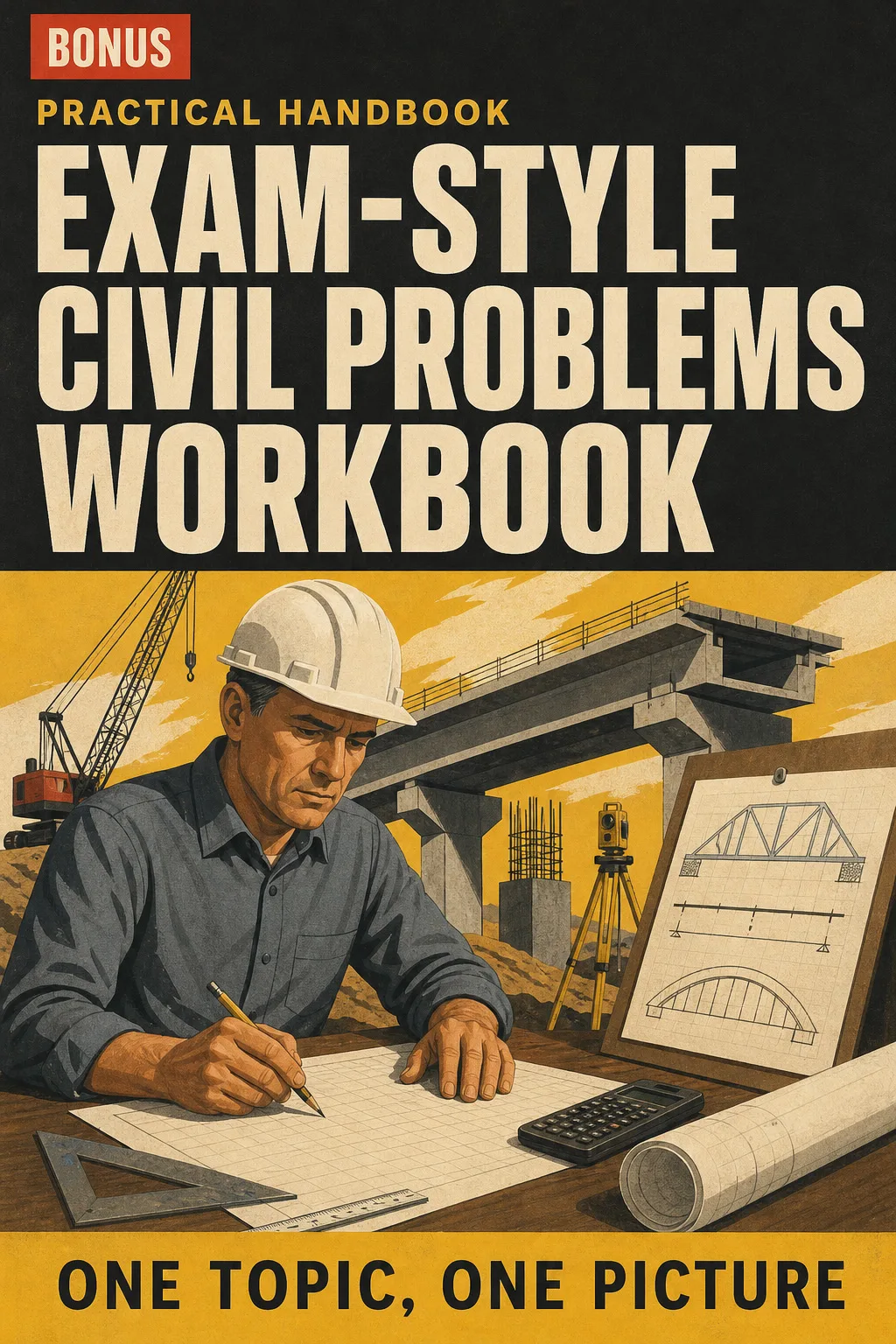
Exam-Style Civil Problems Workbook

BONUS 1: «Exam-Style Civil Problems Workbook»

Value on its own: US$ 17.90

Practice with exam-style questions across all five disciplines, each answer worked out in the same 4 steps as the book, so you see exactly where you went wrong.

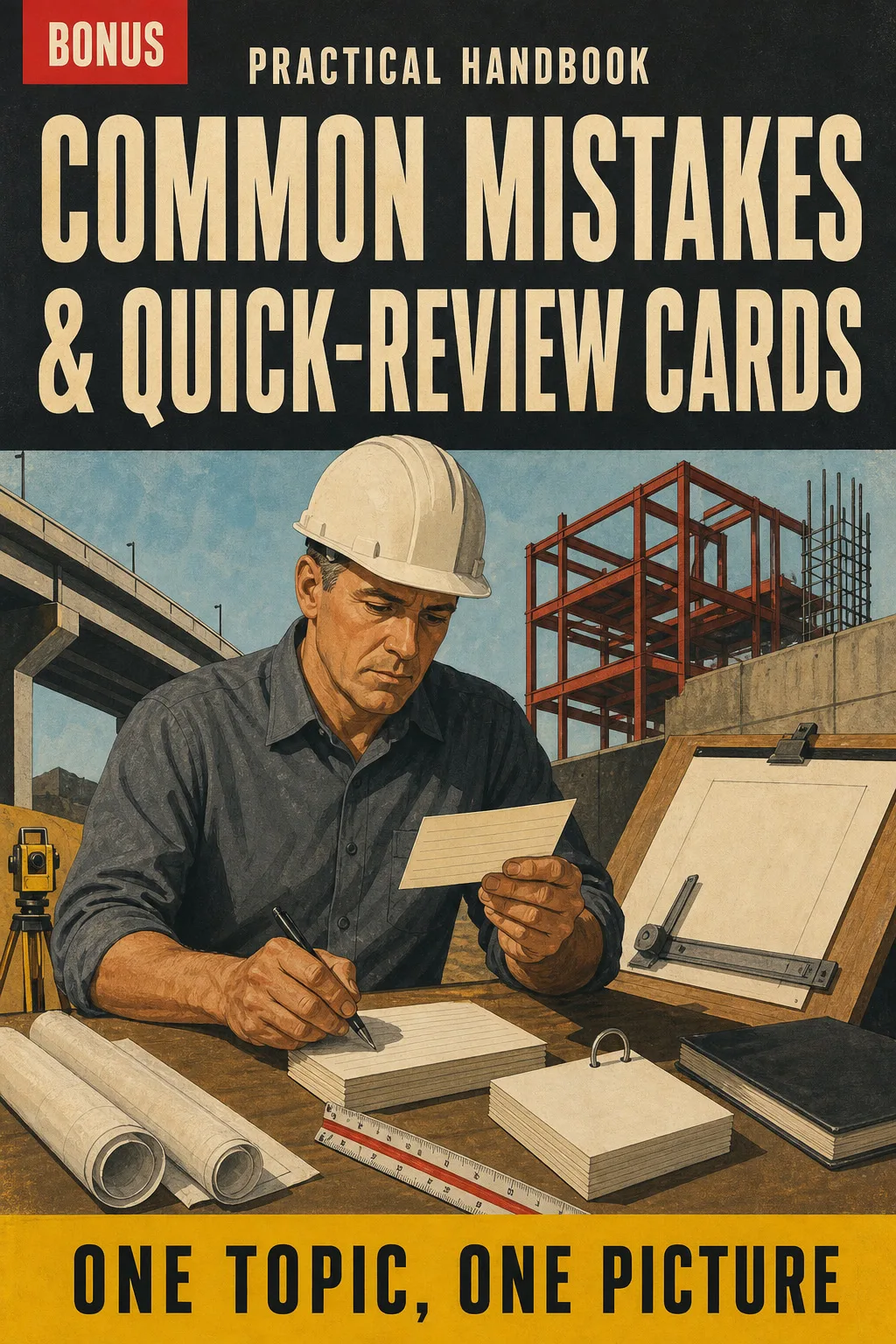
Common Mistakes & Quick-Review Cards

BONUS 2: «Common Mistakes & Quick-Review Cards»

Value on its own: US$ 14.90

The most frequent mistakes shown before and after (wrong units, wrong sign in the moment diagram, wrong Manning n) on printable cards to review in ten minutes a day.

PE Civil Exam Illustrated with 2 Free Books

  • PE Civil Exam Illustrated: 66 illustrated pagesUS$ 87
  • BONUS 1: Exam-Style Civil Problems WorkbookUS$ 17.90
  • BONUS 2: Common Mistakes & Quick-Review CardsUS$ 14.90
  • High-resolution PDF to printIncluded
Total value US$ 119.80
YOUR PRICE:
US$ 37
You save US$ 82.80
YES, I WANT PE CIVIL EXAM ILLUSTRATED FOR US$ 37

📄 This is a digital PDF book sent to your email: nothing is printed or shipped.

Secure purchaseEncrypted payment30-day guarantee

PDF by email: We email you PE Civil Exam Illustrated as a PDF, together with the two free books. It's a single payment: no installments, no extra charges.

Who This Book Is For

You're studying for the PE Civil

You're studying for the PE Civil

Every topic of your module on its own page, solved in the same 4 steps, so your evening study sessions finally connect.

Your exam date is close

Your exam date is close

First attempt or a retake: review the whole core at a glance, practice the handbook search routine, and walk in with a pacing plan for 80 questions.

You already work in civil

You already work in civil

Years on the job and the license is the last step: the theory you haven't touched in years, drawn and ready to print and keep at hand.

Everything You Get Today

US$ 119.80US$ 37
YES, I WANT PE CIVIL EXAM ILLUSTRATED FOR US$ 37

📄 This is a digital PDF book sent to your email: nothing is printed or shipped.

30DAYS
GUARANTEE

30-Day Guarantee

Try PE Civil Exam Illustrated for 30 days, bonus books included.

We refund everything if the file won't open, if the book isn't what you see here, if you were charged twice or if the email doesn't arrive. Just email us.

You pay once. No subscriptions.

Frequently Asked Questions

Is it for me if I've been working for years and haven't taken an exam in two decades?

Yes. It's built for working engineers coming back to theory: each topic starts from the drawing and every worked example follows the same 4 steps, in US units. It covers the core shared by all five modules plus the key topics of each one, so it helps whichever module you take, but it doesn't cover the full depth of your module: use it alongside your module's practice problems. Part VII covers the computer-based format and the searchable reference handbook.

Where does the content come from?

From the published NCEES PE Civil exam specifications and the current PE Civil Reference Handbook, checked against the US codes those specifications list, such as ASCE 7, ACI 318, AISC 360, the AASHTO Green Book, the HCM and OSHA. All drawings and examples are our own.

Is this official material?

No. It's independent study material, not affiliated with or endorsed by NCEES or any state licensing board.

Does it replace a review course?

No, and it doesn't try to. It's 66 illustrated pages: the map that ties the core together, with one worked example per topic in US units. It doesn't replace the long practice sets of a review course or your full manual. It works alongside your course, your practice exams and the reference handbook.

Are the practice questions from the actual exam?

No. The questions are written for this book in an exam-style format. They are not official questions from any exam.

When and how do I get it?

As a PDF by email, sent to the address you enter at checkout. The 2 bonus books come in the same email.

Do I have to pay every month?

No. It's a one-time payment. No subscription.

Can I have it on paper?

Yes. The PDF is printable, so you can print the whole book or just the pages you want to keep at your desk or on site.

How does the refund work?

You have 30 days. We refund everything if the file won't open, if the book isn't what you see on this page, if you were charged twice or if the email doesn't arrive: just email us.

Before You Close This Page

No more rereading without anything sticking.

Soil phases, curves and loads: you see them drawn, and that's it.

You walk into the exam knowing where everything is.

Drawings make studying faster.

The book is right below.

One-time payment: US$ 37 · Guarantee: 30 days · PDF by email

YES, I WANT PE CIVIL EXAM ILLUSTRATED FOR US$ 37

📄 This is a digital PDF book sent to your email: nothing is printed or shipped.